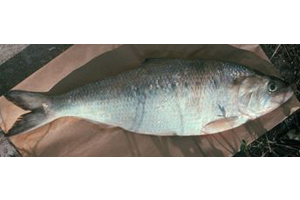
Historically, American shad were abundant in many rivers. By the 1900s, dams, water pollution, and overfishing had decimated most shad populations. Recent river restoration efforts, including construction of waste-water treatment facilities and installation of fish ladders, have allowed shad populations to rebound in many rivers. In addition, a shrub, the shadbush, got its name because it flowered when the shad were running in New England rivers and streams.
Photo Credit: Geoffrey A. Hammerson
Alosa sapidissima
Common Name: American shad
Animal Guild: Fish
Class > Order > Family: Teleostei > Clupeiformes > Clupeidae
What does the species look like?
American shad have a strongly compressed body and no scales on their head, no lateral line, and one dorsal fin. They have a fatty eyelid in front of their eye, no spines in their fins, and sharply pointed scales on their belly; adults have no teeth. Their cheeks are deeper (top to bottom) than they are long (front to rear). Their mouth is not strongly oblique (slanted), and their lower jaw extends to the tip of their snout or slightly beyond. These shad have a green or blue back and silvery sides and a blue-black spot near the upper edge of the gill opening that is usually followed by one or two rows of smaller spots. Their total length can reach up to 75 cm (29.5 inches).
Where is the species found?
States & Provinces
BC, CT, DC, DE, FL, GA, MA, MD, ME, NB, NC, NH, NJ, NL, NS, NY, ON, PA, QC, RI, SC, VA, VT
Distribution
The native range includes the Atlantic coast from Labrador to the St. Johns River in Florida. In the 1870s, this species was introduced in the Sacramento River in California; subsequently, it spread north to Alaska and eastern Asia (Kamchatka Peninsula) and south to Mexico. An introduced, landlocked population occurs in Millerton Lake in California.
American shad migrate up to thousands of kilometers (or thousands of miles) between their spawning habitats in rivers and their feeding habitats in the ocean. In the Atlantic, most American shad are in the Gulf of Maine in summer and fall and move southward to the mid-Atlantic region during the winter.
General Phenology and Life History
The time when American shad migrate upstream to spawn varies across the range. In the south, they spawn in February, but not until June or July in the far north. The timing of migration and spawning also varies among years; shad migrate and spawn later when the water is colder. Eggs hatch in about a week. Larvae and juveniles spend the summer in rivers, then enter the ocean by fall. They return to fresh water when they are mature (3-5 years old). Shad in southern populations tend to die after they spawn, whereas those in more northerly populations survive to spawn in multiple years.
Which phenophases should I observe?
Do you see/hear...?
Activity
Adults More...
For abundance, enter the number of individual animals observed in this phenophase.
Adults in freshwater More...
For abundance, enter the number of individual animals observed in this phenophase.
Adults in saltwater More...
For abundance, enter the number of individual animals observed in this phenophase.
Adults feeding For abundance, enter the number of individual animals observed in this phenophase.
Adults migrating upstream More...
For abundance, enter the number of individual animals observed in this phenophase.
Adults migrating downstream More...
For abundance, enter the number of individual animals observed in this phenophase.
Development
Dead or dying adults For abundance, enter the number of individual animals observed in this phenophase.
Method
Individuals on a hook For abundance, enter the number of individual animals observed in this phenophase.
Individuals in a net For abundance, enter the number of individual animals observed in this phenophase.
What do these phenophases look like?
There is currently no photoguide available for this species. If you'd like help us create one, use the guidance document and species template provided here . Then send it via email to education@usanpn.org when it is complete.