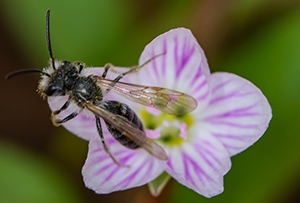
Photo Credit: © bob15noble via iNaturalist.org. Creative Commons Attribution-NonCommercial 4.0 International (CC BY-NC 4.0) License; https://creativecommons.org/licenses/by-nc/4.0/.
Andrena erigeniae
Common Name: spring beauty miner bee
Other Common Names: spring beauty bee
Animal Guild: Insect
Class > Order > Family: Insecta > Hymenoptera > Andrenidae
Where is the species found?
States & Provinces
GA, IN, MN, NS
Which phenophases should I observe?
Do you see/hear...?
Activity Adults
One or more adults are seen or heard moving about or at rest.
More...

For abundance, enter the number of individual animals observed in this phenophase.
Male adults
One or more adult males are seen moving about or at rest. For Andrena erigeniae, males are smaller, slimmer and less hairy than females and often have a fringe of white hairs on their face that resembles a mustache.

For abundance, enter the number of individual animals observed in this phenophase.
Flower visitation
One or more individuals are seen visiting flowers or flying from flower to flower. If possible, record the name of the plant or describe it in the comments field.

For abundance, enter the number of individual animals observed in this phenophase.
Reproduction Mating
A male and female are seen coupled in a mating position, usually with the male on top of the female.

For abundance, enter the number of individual animals observed in this phenophase.
Nest building
One or more adults are seen digging into soil to construct a nest. For Andrena erigeniae, females enter the nest head first, collect soil particles with their front legs, pass them to their hind legs, then push the soil out of the nest as they back out.

For abundance, enter the number of individual animals observed in this phenophase.
Nest provisioning
One or more adults are seen entering the nest with pollen. For Andrena erigeniae, pollen is carried between hairs on the hind legs and looks like pink "fuzz".

For abundance, enter the number of individual animals observed in this phenophase.
Development Dead adults
One or more dead adults are seen.

For abundance, enter the number of individual animals observed in this phenophase.
Method Individuals in a trap
One or more individuals are seen caught in a trap.

For abundance, enter the number of individual animals observed in this phenophase.
What do these phenophases look like?

There is currently no photoguide available for this species. If you'd like help us create one, use the guidance document and species template provided here. Then send it via email to education@usanpn.org when it is complete.