This species visits flowers out in the desert but also likes verbenas and lantanas in urban gardens.

Photo Credit: Megan McCarty via Wikimedia Commons
Battus philenor
Common Name: pipevine swallowtail
Animal Guild: Insect
Class > Order > Family: Insecta > Lepidoptera > Papilionidae
What does the species look like?

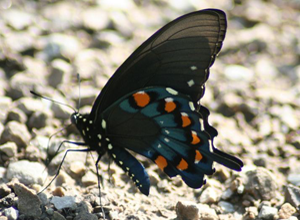
 The upper surface of this species’ hindwings is iridescent blue or blue-green. The underside of the hindwing has a row of seven round orange spots on an otherwise iridescent blue background. The upper surface of adult males is brighter blue than adult females.

Caterpillars are black or red and covered with fleshy (usually red over most of the body and black near the head) projections. There are two such projections that are especially large near the head.

Total adult length: 2.5 to 3.25 inches (63.5 – 82.55 mm).

Similar species: The red-spotted purple is a similar species, but has a more blue appearance overall and additional orange spots on the undersides of the forewings.

Where is the species found?
States & Provinces
AL, AR, AZ, CA, CO, CT, DC, DE, FL, GA, IA, IL, IN, KS, KY, LA, MD, ME, MI, MO, MS, NC, NJ, NM, NY, OH, OK, OR, PA, SC, TN, TX, VA, WV
Distribution

This species occurs across most of the United States in open areas throughout the regions.

General Phenology and Life History

Flying April to October northward, year round in the south.

This species is one of the first ones to be seen on summer mornings. On hot days adults visit puddles and damp spots. The host plant for this species is pipevines, hence the common name. Caterpillars are gregarious – they line up in a group along the margins of leaves.

Which phenophases should I observe?
Do you see/hear...?
Activity Adults
One or more adults are seen or heard moving about or at rest.
More...

For abundance, enter the number of individual animals observed in this phenophase.
Adults feeding
One or more adults are seen feeding with their straw-like tongue (proboscis). If possible, record the substance and species on which they are feeding (for example, nectar, sap, dung, or moist soil) in the comments field. For Battus philenor, adults feed on the flower nectar of many different plant species.

For abundance, enter the number of individual animals observed in this phenophase.
Flower visitation
One or more individuals are seen visiting flowers or flying from flower to flower. If possible, record the name of the plant or describe it in the comments field.

For abundance, enter the number of individual animals observed in this phenophase.
Reproduction Mating
A male and female are seen coupled in a mating position, usually end to end. This can occur at rest or in flight.

For abundance, enter the number of individual animals observed in this phenophase.
Egg laying
A female is seen laying eggs on a plant or other surface. If possible, record the name of the plant or describe it in the comments field. For Battus philenor, eggs are typically deposited in clusters on pipevine plants.

For abundance, enter the number of individual animals observed in this phenophase.
Eggs
One or more eggs are seen on a plant or other surface. If possible, record the name of the plant or describe it in the comments field. For Battus philenor, the small, rough-textured, spherical eggs are orange to red in color, and are typically found in clusters on the leaves or stems of pipevine plants.

For abundance, enter the number of individual animals observed in this phenophase.
Development Caterpillars
One or more caterpillars (larvae) are seen moving about or at rest. When seen on a plant, if possible, record the name of the plant or describe it in the comments field. For Battus philenor, caterpillars are dark brown to black (sometimes dark red) with rows of bright orange or red projections (tubercules) along their back.

For abundance, enter the number of individual animals observed in this phenophase.
Caterpillars feeding
One or more caterpillars are seen feeding. If possible, record the name of the species or substance being eaten or describe it in the comments field. For Battus philenor, caterpillars typically feed on pipevine plants.

For abundance, enter the number of individual animals observed in this phenophase.
Pupae
One or more pupae are seen in a cocoon or shell (puparium). For Battus philenor, pupae are green or brown with purple-edged, wing-like extensions, somewhat resembling a dried, curled leaf. They hang from plants or other outdoor surfaces. Do not include empty pupal shells after the adult has emerged from them.

For abundance, enter the number of individual animals observed in this phenophase.
Dead adults
One or more dead adults are seen.

For abundance, enter the number of individual animals observed in this phenophase.
Dead caterpillars
One or more dead caterpillars are seen.

For abundance, enter the number of individual animals observed in this phenophase.
Method Individuals at a feeding station
One or more individuals are seen visiting a feeder, feeding station, or food placed by a person.

For abundance, enter the number of individual animals observed in this phenophase.
Individuals in a net
One or more individuals are seen caught in a net.

For abundance, enter the number of individual animals observed in this phenophase.
Individuals in a trap
One or more individuals are seen caught in a trap.

For abundance, enter the number of individual animals observed in this phenophase.
What do these phenophases look like?

There is currently no photoguide available for this species. If you'd like help us create one, use the guidance document and species template provided here. Then send it via email to education@usanpn.org when it is complete.