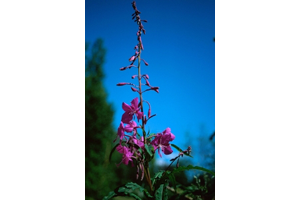
Fireweed is the floral emblem of Yukon Territory. This species is called fireweed because it is one of the first plants to come up after fire. Fireweed is native to the U.S. and is in the Onagraceae (Evening Primrose family).
Photo Credit: © John J. Mosesso http://life.nbii.gov
Chamerion angustifolium
Common Name: fireweed
Plant Functional Group: Forb
Class > Order > Family: Magnoliopsida > Myrtales > Onagraceae
What does the species look like?
Chamerion angustifolium is a perennial, herbaceous forb with an upright growth habit. The leaves of fireweed are unique in that the leaf veins are circular and do not terminate on the edges of the leaf, but form circular loops and join together inside the outer leaf margins. The flower has pink to purple racemes. The fruit is a reddish-brown seed capsule with 300 to 500 brown seeds. The seeds have silky hairs that aid in wind dispersal. The plants spread by underground rhizomes. Fireweed has a rapid growth rate.
Fireweed is found in wet, cool places such as cut-over or burned forests and swamps, avalanche areas, recently deglaciated areas, riverbars, and human-disturbed areas. It can be abundant in coniferous forests, mixed forests, aspen parkland, grasslands, and muskeg.
Fireweed attracts bees, moths, and hummingbirds. It is the larval host to the white lined sphinx moth. Moose, deer, and caribou eat the leaves, and small mammals eat the seeds. In addition, butterflies use the nectar and pollen, and bees produce a delicious honey from the flowers.
Where is the species found?
States & Provinces
AB, AK, AZ, BC, CA, CO, CT, DC, DE, IA, ID, IL, IN, MA, MB, MD, ME, MI, MT, NB, NC, ND, NE, NH, NJ, NL, NM, NS, NT, NU, NV, NY, OH, ON, OR, PA, PE, QC, RI, SD, SK, TN, UT, VA, VT, WA, WI, WV, WY, YT
Special Considerations for Observing
If drought seems to be the cause of leaf color or fall for a plant, please make a comment about it for that observation.
Which phenophases should I observe?
Do you see...?
Leaves
Initial growth More...
Leaves More...
Flowers
Flowers or flower buds More...
How many flowers and flower buds are present? For species in which individual flowers are clustered in flower heads, spikes or catkins (inflorescences), simply estimate the number of flower heads, spikes or catkins and not the number of individual flowers.
Less than 3 3 to 10 11 to 100 101 to 1,000 More than 1,000
Open flowers More...
What percentage of all fresh flowers (buds plus unopened plus open) on the plant are open? For species in which individual flowers are clustered in flower heads, spikes or catkins (inflorescences), estimate the percentage of all individual flowers that are open.
Less than 5% 5-24% 25-49% 50-74% 75-94% 95% or more
Fruits
Fruits Chamerion angustifolium , the fruit is a capsule that changes from green to reddish-brown and splits open to expose seeds with white fluff. Do not include empty capsules that have already dropped all of their seeds.More...
How many fruits are present?
Less than 3 3 to 10 11 to 100 101 to 1,000 More than 1,000
Ripe fruits Chamerion angustifolium , a fruit is considered ripe when it has turned reddish-brown and has split open to expose seeds with white fluff. Do not include empty capsules that have already dropped all of their seeds.More...
What percentage of all fruits (unripe plus ripe) on the plant are ripe?
Less than 5% 5-24% 25-49% 50-74% 75-94% 95% or more
Recent fruit or seed drop More...
How many mature fruits have dropped seeds or have completely dropped or been removed from the plant since your last visit?
Less than 3 3 to 10 11 to 100 101 to 1,000 More than 1,000
What do these phenophases look like?
There is currently no photoguide available for this species. If you'd like help us create one, use the guidance document and species template provided here . Then send it via email to education@usanpn.org when it is complete.