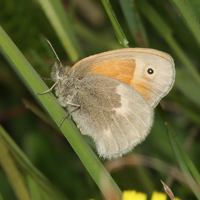
Photo Credit: Mdf via Wikimedia Commons. License: GNU Free Documentation License, Version 1.2 or any later version, Creative Commons Attribution-Share Alike 3.0 Unported license (http://creativecommons.org/licenses/by-sa/3.0/deed.en)
Coenonympha tullia
Common Name: common ringlet
Other Common Names: California ringlet
Animal Guild: Insect
Class > Order > Family: Insecta > Lepidoptera > Nymphalidae
Where is the species found?
States & Provinces
AB, AK, AZ, BC, CA, CO, CT, IA, ID, KS, MA, MB, ME, MI, MN, MT, NB, ND, NE, NH, NJ, NL, NM, NT, NU, NV, NY, ON, OR, PA, PE, QC, RI, SD, SK, UT, VT, WA, WI, WV, WY, YT
Which phenophases should I observe?
Do you see/hear...?
Activity
Adults More...
For abundance, enter the number of individual animals observed in this phenophase.
Adults feeding Coenonympha tullia , adults feed on the flower nectar of many different plant species.
For abundance, enter the number of individual animals observed in this phenophase.
Flower visitation For abundance, enter the number of individual animals observed in this phenophase.
Reproduction
Mating For abundance, enter the number of individual animals observed in this phenophase.
Egg laying Coenonympha tullia , eggs are typically deposited on the leaves of grass plants.
For abundance, enter the number of individual animals observed in this phenophase.
Eggs Coenonympha tullia , the tiny, ribbed, barrel-shaped eggs are initially whitish, becoming tan with orange-brown or pinkish mottling as they develop, and are typically found on the leaves of grass plants.
For abundance, enter the number of individual animals observed in this phenophase.
Development
Caterpillars Coenonympha tullia , caterpillars are green to brown with several pale white to yellow lateral stripes. The abdomen ends in a forked tip.
For abundance, enter the number of individual animals observed in this phenophase.
Caterpillars feeding Coenonympha tullia , caterpillars typically feed on grass plants.
For abundance, enter the number of individual animals observed in this phenophase.
Pupae Coenonympha tullia , pupae are enclosed in a green, translucent shell (chrysalis) that appears orange-brown as the butterfly develops, and hang from grass plants or other outdoor surfaces. Do not include empty pupal shells after the adult has emerged from them.
For abundance, enter the number of individual animals observed in this phenophase.
Dead adults For abundance, enter the number of individual animals observed in this phenophase.
Dead caterpillars For abundance, enter the number of individual animals observed in this phenophase.
Method
Individuals at a feeding station For abundance, enter the number of individual animals observed in this phenophase.
Individuals in a net For abundance, enter the number of individual animals observed in this phenophase.
Individuals in a trap For abundance, enter the number of individual animals observed in this phenophase.
What do these phenophases look like?
There is currently no photoguide available for this species. If you'd like help us create one, use the guidance document and species template provided here . Then send it via email to education@usanpn.org when it is complete.