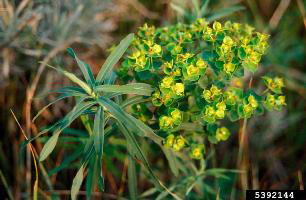
The milky latex found in leafy spurge can cause skin, mouth, and digestive irritation in humans and cattle, yet sheep and goats can graze on this plant with no ill effects.
Photo Credit: © John M. Randall, The Nature Conservancy, Bugwood.org.
Euphorbia esula
Common Name: leafy spurge
Other Common Names: spurge, wolf's milk, wolf's-milk
Plant Functional Group: Forb
Class > Order > Family: Magnoliopsida > Malpighiales > Euphorbiaceae
What does the species look like?
Leafy spurge is an erect, perennial, herbaceous plant, growing 8 to 36 inches tall, with extensive roots and underground creeping stems. Its tiny, greenish flowers are a bit unusual, with one female flower surrounded by several male flowers into a small "flower" (cyanthium). Several to many cyanthia are clustered loosely at the tops of branches; the flowers are insect- and self-pollinated.
Leafy spurge is found in both wet and dry climates, in subtropical to subarctic regions, and in riparian areas to dry hillsides. It can tolerate four and one-half months of flooding. It grows better in coarse-textured soils than in fine-textured soils, and occurs along roadsides, cultivated fields and gardens, and old fields, waste places, dunes, pastures, meadows, sandy banks, river banks, rangeland, and open woodlands.
Where is the species found?
States & Provinces
AB, AZ, BC, CA, CO, CT, DE, IA, ID, IL, IN, KS, MA, MB, MD, ME, MI, MN, MO, MT, NB, ND, NE, NH, NJ, NM, NS, NV, NY, OH, ON, OR, PA, PE, QC, SD, SK, UT, VA, VT, WA, WI, WV, WY, YT
Special Considerations for Observing
If drought seems to be the cause of leaf senescence for a plant, please make a comment about it for that observation.
Which phenophases should I observe?
Do you see...?
Leaves
Initial growth More...
Leaves More...
Flowers
Flowers or flower buds More...
How many flowers and flower buds are present? For species in which individual flowers are clustered in flower heads, spikes or catkins (inflorescences), simply estimate the number of flower heads, spikes or catkins and not the number of individual flowers.
Less than 3 3 to 10 11 to 100 101 to 1,000 More than 1,000
Open flowers More...
What percentage of all fresh flowers (buds plus unopened plus open) on the plant are open? For species in which individual flowers are clustered in flower heads, spikes or catkins (inflorescences), estimate the percentage of all individual flowers that are open.
Less than 5% 5-24% 25-49% 50-74% 75-94% 95% or more
Fruits
Fruits Euphorbia esula , the fruit is a green capsule that dries and splits open, sometimes explosively, to expose the seeds. Do not include empty capsules that have already dropped all of their seeds.More...
How many fruits are present?
Less than 3 3 to 10 11 to 100 101 to 1,000 More than 1,000
Ripe fruits Euphorbia esula , a fruit is considered ripe when it has dried and split open to expose the seeds. Do not include empty capsules that have already dropped all of their seeds.More...
What percentage of all fruits (unripe plus ripe) on the plant are ripe?
Less than 5% 5-24% 25-49% 50-74% 75-94% 95% or more
Recent fruit or seed drop More...
How many mature fruits have dropped seeds or have completely dropped or been removed from the plant since your last visit?
Less than 3 3 to 10 11 to 100 101 to 1,000 More than 1,000
What do these phenophases look like?
There is currently no photoguide available for this species. If you'd like help us create one, use the guidance document and species template provided here . Then send it via email to education@usanpn.org when it is complete.