|
Do you see/hear...?
|
| Activity
|
Adults
One or more adults are seen or heard moving about or at rest.
More...
For abundance, enter the number of individual animals observed in this phenophase.
|
|
|
Adults feeding
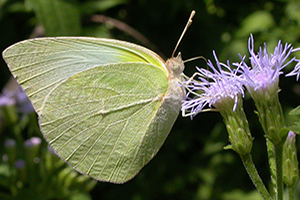
One or more adults are seen feeding with their straw-like tongue (proboscis). If possible, record the substance and species on which they are feeding (for example, nectar, sap, dung, or moist soil) in the comments field. For Kricogonia lyside, adults feed on the flower nectar of many different plant species.
For abundance, enter the number of individual animals observed in this phenophase.
|
|
|
Flower visitation
One or more individuals are seen visiting flowers or flying from flower to flower. If possible, record the name of the plant or describe it in the comments field.
For abundance, enter the number of individual animals observed in this phenophase.
|
|
|
Migrating adults
Multiple adults of the same species are seen flying steadily in a uniform direction without stopping.
More...
For abundance, enter the number of individual animals observed in this phenophase.
|
| Reproduction
|
Mating
A male and female are seen coupled in a mating position, usually end to end. This can occur at rest or in flight.
For abundance, enter the number of individual animals observed in this phenophase.
|
|
|
Egg laying
A female is seen laying eggs on a plant or other surface. If possible, record the name of the plant or describe it in the comments field. For Kricogonia lyside, eggs are typically deposited on lignumvitae, guayacan or other plants in the creosote-bush family (Zygophyllaceae).
For abundance, enter the number of individual animals observed in this phenophase.
|
|
|
Eggs
One or more eggs are seen on a plant or other surface. If possible, record the name of the plant or describe it in the comments field. For Kricogonia lyside, the tiny, spindle-shaped eggs are white to yellow in color, and are typically found on lignumvitae, guayacan or other plants in the creosote-bush family (Zygophyllaceae).
For abundance, enter the number of individual animals observed in this phenophase.
|
| Development
|
Caterpillars
One or more caterpillars (larvae) are seen moving about or at rest. When seen on a plant, if possible, record the name of the plant or describe it in the comments field. For Kricogonia lyside, caterpillars are green or brown and often develop lateral white stripes as they get older.
For abundance, enter the number of individual animals observed in this phenophase.
|
|
|
Caterpillars feeding
One or more caterpillars are seen feeding. If possible, record the name of the species or substance being eaten or describe it in the comments field. For Kricogonia lyside, caterpillars typically feed on lignumvitae, guayacan or other plants in the creosote-bush family (Zygophyllaceae).
For abundance, enter the number of individual animals observed in this phenophase.
|
|
|
Pupae
One or more pupae are seen in a cocoon or shell (puparium). For Kricogonia lyside, pupae are enclosed in a green, translucent shell (chrysalis) that appears darker as the butterfly develops, and hang from plants or other outdoor surfaces. Do not include empty pupal shells after the adult has emerged from them.
For abundance, enter the number of individual animals observed in this phenophase.
|
|
|
Dead adults
One or more dead adults are seen.
For abundance, enter the number of individual animals observed in this phenophase.
|
|
|
Dead caterpillars
One or more dead caterpillars are seen.
For abundance, enter the number of individual animals observed in this phenophase.
|
| Method
|
Individuals at a feeding station
One or more individuals are seen visiting a feeder, feeding station, or food placed by a person.
For abundance, enter the number of individual animals observed in this phenophase.
|
|
|
Individuals in a net
One or more individuals are seen caught in a net.
For abundance, enter the number of individual animals observed in this phenophase.
|
|
|
Individuals in a trap
One or more individuals are seen caught in a trap.
For abundance, enter the number of individual animals observed in this phenophase.
|