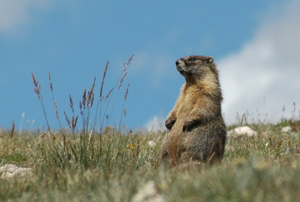
Yellow-bellied marmot communicate with sounds and chemical signals. They whistle to alert others to danger, and they use their cheek glands to leave scent marks that may help convey social status and other messages.
Photo Credit: Geoffrey A. Hammerson
Marmota flaviventris
Common Name: yellow-bellied marmot
Animal Guild: Mammal
Class > Order > Family: Mammalia > Rodentia > Sciuridae
What does the species look like?
Their coarse-looking fur is yellow-brown, and they have a buffy band on the side of their neck. Most have a whitish band across their snout. Their tail is short and bushy. They typically reach about 26.8 inches (68 cm) in total length.
Where is the species found?
States & Provinces
AB, BC, CO, MT, UT, WY
Distribution
Their range includes western North America from south-central British Columbia and southern Alberta southward to Southern California, Nevada, southern Utah, and the Sangre de Cristo Mountains in northern New Mexico.
Yellow-bellied marmots occupy alpine tundra, subalpine and montane meadows, and foothills and canyons at lower elevations.
General Phenology and Life History
At higher elevations, these marmots hibernate from early September to May; at lower elevations, they may emerge as early as February to mid-March. They typically mate shortly after emergence from hibernation. The young emerge from their burrow in late June or July in the mountains of western Colorado, but the timing varies with elevation and the timing of the snow melt. In some lower elevation areas, marmots may estivate (rest or go dormant) during dry periods in summer. They are generally active in daylight, but their activities vary seasonally.
Which phenophases should I observe?
Do you see/hear...?
Activity
Live individuals More...
For abundance, enter the number of individual animals observed in this phenophase.
Feeding or foraging For abundance, enter the number of individual animals observed in this phenophase.
Development
Young individuals For abundance, enter the number of individual animals observed in this phenophase.
Dead individuals For abundance, enter the number of individual animals observed in this phenophase.
Dead young For abundance, enter the number of individual animals observed in this phenophase.
What do these phenophases look like?
There is currently no photoguide available for this species. If you'd like help us create one, use the guidance document and species template provided here . Then send it via email to education@usanpn.org when it is complete.