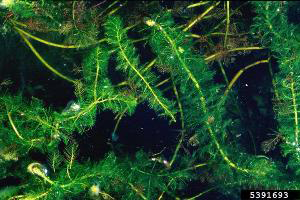
Eurasian watermilfoil can spread when fragments of the plant float to new locations.

Photo Credit: © Barry Rice, sarracenia.com, Bugwood.org.
Myriophyllum spicatum
Common Name: Eurasian watermilfoil
Other Common Names: Eurasian water-milfoil, myriophylle en epi, spike watermilfoil, spiked water milfoil
Plant Functional Group: Forb
Class > Order > Family: Magnoliopsida > Saxifragales > Haloragaceae
What does the species look like?

Eurasian watermilfoil has an evergreen to an annual pattern of growth (depending on local conditions). It is a submerged aquatic, rooted, perennial, herbaceous plant, growing 6 to 20 feet long, or much longer, and frequently forming dense mats. Its small, yellow to pinkish flowers are clustered at the tips of the stems and located above the water's surface, often remaining above the surface until pollination is complete, then resubmerging. The flowers have either male or female parts, with both arranged along a reddish spike at the ends of stems. On the spike, the male flowers are located above the female flowers, which are pollinated by wind, and less common by insects.

Eurasian watermilfoil is a submerged plant tolerating a wide range of water conditions, including still and flowing waters, spring water, and the brackish and saline (salty) water of tidal creeks and bays. It appears to prefer lakes, ponds, and slow-moving rivers, and streams, but can also quickly in fast-moving water. It requires high light locations and can grow in a broad range of temperatures. It grows best on fine-textured, inorganic sediments, and relatively poorly on highly organic sediments.

Where is the species found?
States & Provinces
AK, AL, AR, AZ, BC, CA, CO, CT, DE, FL, GA, IA, IL, IN, KY, LA, MA, MD, MI, MN, MO, MS, MT, NB, NC, ND, NE, NH, NJ, NM, NY, OH, OK, ON, OR, PA, QC, SC, SD, TN, TX, UT, VA, VT, WA, WI, WV
Special Considerations for Observing

If drought seems to be the cause of leaf senescence for a plant, please make a comment about it for that observation.

This species has separate male and female flowers. If you know whether the flowers you are observing are male or female (or both), please make a comment about it for that observation.


Which phenophases should I observe?
Do you see...?
Leaves Initial growth
New growth of the plant is visible after a period of no growth (winter or drought), either from above-ground buds with green tips, or new green or white shoots breaking through the soil surface. Growth is considered "initial" on each bud or shoot until the first leaf has fully unfolded. For seedlings, "initial" growth includes the presence of the one or two small, round or elongated leaves (cotyledons) before the first true leaf has unfolded.
More...


Leaves
One or more live, fully unfolded leaves are visible on the plant. For seedlings, consider only true leaves and do not count the one or two small, round or elongated leaves (cotyledons) that are found on the stem almost immediately after the seedling germinates. Do not include fully dried or dead leaves.
More...


Flowers Flowers or flower buds
One or more fresh open or unopened flowers or flower buds are visible on the plant. Include flower buds or inflorescences that are swelling or expanding, but do not include those that are tightly closed and not actively growing (dormant). Also do not include wilted or dried flowers.
More...

How many flowers and flower buds are present? For species in which individual flowers are clustered in flower heads, spikes or catkins (inflorescences), simply estimate the number of flower heads, spikes or catkins and not the number of individual flowers.

  • Less than 3
  • 3 to 10
  • 11 to 100
  • 101 to 1,000
  • More than 1,000

Open flowers
One or more open, fresh flowers are visible on the plant. Flowers are considered "open" when the reproductive parts (male stamens or female pistils) are visible between or within unfolded or open flower parts (petals, floral tubes or sepals). Do not include wilted or dried flowers.
More...

What percentage of all fresh flowers (buds plus unopened plus open) on the plant are open? For species in which individual flowers are clustered in flower heads, spikes or catkins (inflorescences), estimate the percentage of all individual flowers that are open.

  • Less than 5%
  • 5-24%
  • 25-49%
  • 50-74%
  • 75-94%
  • 95% or more

Fruits Fruits
One or more fruits are visible on the plant. For Myriophyllum spicatum, the fruit is a tight cluster of four nutlets that becomes hard and dry, and then the nutlets separate.
More...

How many fruits are present?

  • Less than 3
  • 3 to 10
  • 11 to 100
  • 101 to 1,000
  • More than 1,000

Ripe fruits
One or more ripe fruits are visible on the plant. For Myriophyllum spicatum, a fruit is considered ripe when it has turned hard and dry.
More...

What percentage of all fruits (unripe plus ripe) on the plant are ripe?

  • Less than 5%
  • 5-24%
  • 25-49%
  • 50-74%
  • 75-94%
  • 95% or more

Recent fruit or seed drop
One or more mature fruits or seeds have dropped or been removed from the plant since your last visit. Do not include obviously immature fruits that have dropped before ripening, such as in a heavy rain or wind, or empty fruits that had long ago dropped all of their seeds but remained on the plant.
More...

How many mature fruits have dropped seeds or have completely dropped or been removed from the plant since your last visit?

  • Less than 3
  • 3 to 10
  • 11 to 100
  • 101 to 1,000
  • More than 1,000

What do these phenophases look like?

There is currently no photoguide available for this species. If you'd like help us create one, use the guidance document and species template provided here. Then send it via email to education@usanpn.org when it is complete.