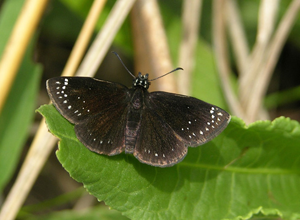
The upperside of the Common Sootywing is glossy black with small white spots on the outer third of the forewing. The females have more white spots on the forewings than the males, and a row of spots on the hindwing occurs just in from the margin. The underside of forewing repeats the upperside, while the hindwing is solid black.
Caterpillars are green with an oval head capsule.
Total adult length: 1 to 1.3 inches (25 – 35 mm).
Similar species: The Golden-Headed Scallopwing (Staphylus ceos) is a similar species, but as its names suggests, it has a golden head and adults are faster flying than the Common Sootywing.
This species occurs across the most of the United States and the western Canadian provinces.
Common Sootywings prefer riparian habitats or cropland/hedgerow, grassland/herbaceous, old field, suburban/orchard weedy backyards, vacant lots, landfills, edges of croplands; any place where the weedy annual plants that it prefers grow in the open. They are very seldom in any kind of natural setting in most of their range. This species can occur in more natural settings, such as gulches in the southwest.
Common Sootywings overwinter as fully fed caterpillars, pupating in April. There are typically two broods; from May-August in the north, March-November in Texas. Caterpillars feed on Lambsquarters (Chenopodium album), amaranths (Amaranthus), and cockscomb (Celosia). Adults feed on nectar from many flowers including dogbane, marjoram, oxalis, white clover, common milkweed, peppermint, cucumber, and melon.
Adults bask with the wings spread open. To find receptive females, males patrol near the ground in sunny places to mate during the morning or afternoon. Near midday, females lay eggs singly on the tops of host plant leaves. Caterpillars live and feed within shelters of folded leaves. Caterpillars of the second brood overwinter in their silk-lined leaf shelters and pupate within them in the spring.
There is currently no photoguide available for this species. If you'd like help us create one, use the guidance document and species template provided here. Then send it via email to education@usanpn.org when it is complete.