Black spruce was brewed into spruce beer by lumbermen, and the resin was used as chewing gum.

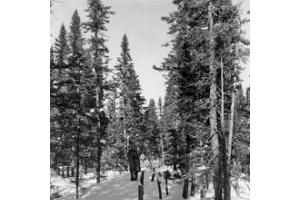
Photo Credit: © USDA-NRCS PLANTS Database.
Picea mariana
Common Name: black spruce
Other Common Names: bog spruce, shortleaf black spruce, swamp spruce
Plant Functional Group: Evergreen conifer
Class > Order > Family: Pinopsida > Pinales > Pinaceae
What does the species look like?

Black spruce is an evergreen conifer growing 40 to 80 feet tall. Male and female cones are present on the same tree. The plant becomes mature and can produce cones at about 30 years of age. The dark red to purplish male cones bear pollen. The larger female cones start as dark purple, maturing to purple-brown. Pollination occurs by wind.

Black spruce grows in cold climates, on lowland and upland sites. It can be found on a variety of soil types, including bogs, and coniferous forests, and is adapted to growing on permafrost soils (soils that remain below freezing). It is typically the last tree species to survive as the forest grades into treeless communities in the far north.

Where is the species found?
States & Provinces
AB, AK, BC, CT, IL, MA, MB, ME, MI, MN, NB, NH, NJ, NL, NS, NT, NU, NY, ON, PA, PE, QC, RI, SK, VT, WI, YT
Which phenophases should I observe?
Do you see...?
Needles Breaking needle buds
One or more breaking needle buds are visible on the plant. A needle bud is considered "breaking" once a green needle tip is visible at the end of the bud, but before the first needle from the bud has unfolded and spread away at an angle from the developing stem.
More...

How many buds are breaking?

  • Less than 3
  • 3 to 10
  • 11 to 100
  • 101 to 1,000
  • 1,001 to 10,000
  • More than 10,000

Young needles
One or more young, unfolded needles are visible on the plant. A needle is considered "young" and "unfolded" once it has spread away from the developing stem enough that its point of attachment to the stem is visible, but before it has reached full size or turned the darker green color or tougher texture of mature needles on the plant.

How many young needles are present?

  • Less than 3
  • 3 to 10
  • 11 to 100
  • 101 to 1,000
  • 1,001 to 10,000
  • More than 10,000

Pollen cones Pollen cones
One or more fresh pollen cones (male strobili) are visible on the plant. Cones have overlapping scales that are initially tightly closed, then spread apart to open the cone and release pollen. Include cones that are unopened or open, but do not include wilted or dried cones that have already released all of their pollen.
More...

How many fresh pollen cones are present?

  • Less than 3
  • 3 to 10
  • 11 to 100
  • 101 to 1,000
  • 1,001 to 10,000
  • More than 10,000

Open pollen cones
One or more open, fresh pollen cones (male strobili) are visible on the plant. Cones are considered "open" when the scales have spread apart to release pollen. Do not include wilted or dried cones that have already released all of their pollen.

What percentage of all fresh pollen cones (unopened plus open) on the plant are open?

  • Less than 5%
  • 5-24%
  • 25-49%
  • 50-74%
  • 75-94%
  • 95% or more

Pollen release
One or more pollen cones (male strobili) on the plant release visible pollen grains when gently shaken or blown into your palm or onto a dark surface.
More...

How much pollen is released?

  • Little: Only a few grains are released.
  • Some: Many grains are released.
  • Lots: A layer of pollen covers your palm, or a cloud of pollen can be seen in the air when the wind blows

Seed cones Seed cones
One or more seed cones (female strobili) are visible on the plant. For Picea mariana, the seed cone is first visible in upper branches as a small conelet covered with soft, reddish-purple, leaf-like bracts. As it enlarges, it hardens and changes from green to purplish to purple-brown or brown, and scales spread apart to expose the winged seeds. Do not include empty cones that have already dropped all of their seeds.

How many seed cones are present?

  • Less than 3
  • 3 to 10
  • 11 to 100
  • 101 to 1,000
  • 1,001 to 10,000
  • More than 10,000

Ripe seed cones
One or more ripe seed cones (female strobili) are visible on the plant. For Picea mariana, a seed cone is considered ripe when it has turned purple-brown or brown and the scales have begun to spread apart to expose the winged seeds inside. Do not include empty cones that have already dropped all of their seeds.
More...

What percentage of all seed cones (unripe plus ripe) on the plant are ripe?

  • Less than 5%
  • 5-24%
  • 25-49%
  • 50-74%
  • 75-94%
  • 95% or more

Recent cone or seed drop
One or more seed cones or seeds have dropped or been removed from the plant since your last visit. Do not include empty seed cones that had long ago dropped all of their seeds but remained on the plant.
More...

How many seed cones have dropped seeds or have completely dropped or been removed from the plant since your last visit?

  • Less than 3
  • 3 to 10
  • 11 to 100
  • 101 to 1,000
  • 1,001 to 10,000
  • More than 10,000

What do these phenophases look like?

There is currently no photoguide available for this species. If you'd like help us create one, use the guidance document and species template provided here. Then send it via email to education@usanpn.org when it is complete.