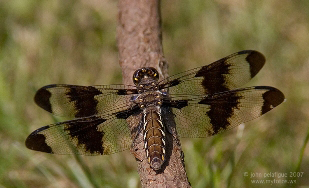
Common whitetails spend a lot of their time patrolling ponds and defending their territories from other males. When they meet another male, they raise their distinct white abdomen and fly toward the intruder. Females, on the other hand, visit ponds only briefly to mate and lay eggs.
Photo Credit: John Pelafigue
Plathemis lydia
Common Name: common whitetail
Animal Guild: Insect
Class > Order > Family: Insecta > Odonata > Libellulidae
What does the species look like?
Both sexes: This species is medium-sized, low-perching, and stout with a shape like that of a biplane. In both sexes, the abdomen is brown with an interrupted white line laterally, appearing as individual stripes. The legs are brown. Adults have brown spots on parts of the wings. The face is yellowish-brown initially, but becomes noticeably darker in both sexes; the top of the head is deep brown. The eyes of both sexes are dark brown.
Males: Males have powdery white tails and a wide brown stripe across the center of each wing. The male thorax is dark brown with two pale lateral stripes that fade with age. The wings of the male have an elongate basal patch of black on the leading edge and a broad black band across the middle third.
Females: Females and juveniles have brown tails with white or yellow lateral sides and brown, irregularly shaped spots at the base, center, and tip of each wing. The abdomen is brown with broken, angled, yellowish lateral patches. The female wings have a patch at the base, a large irregularly shaped patch at the center, and a broad black tip.
Total length: 38-48 mm; abdomen: 23-29 mm; hindwing: 29-35 mm.
Similar Species: Adult males are distinct with large black wing spots and powdery white abdomens. Females are also fairly easy to identify but may resemble twelve-spotted skimmers (Libellula pulchella) but are distinguished by their heavier abdomens and row of triangle shaped spots on their sides as well as their habit of perching on the ground. The female is also somewhat similar to the prince baskettail (Epitheca princeps) which has the same wing pattern but the abdomen is slender and unmarked.
Where is the species found?
States & Provinces
AL, AR, AZ, BC, CA, CO, CT, DE, FL, GA, IA, ID, IL, IN, KS, KY, LA, MA, MB, MD, ME, MI, MN, MO, MS, MT, NB, NC, ND, NE, NH, NJ, NL, NM, NS, NV, NY, OH, OK, ON, OR, PA, PE, QC, RI, SC, SD, TN, TX, UT, VA, VT, WA, WI, WV, WY
Distribution
This species is found throughout the United States, all of southern Canada, and parts of Mexico.
It frequents a variety of wetlands, including ponds, and slow-moving, muddy-bottomed rivers and streams, as well as marshes. It may also commonly be seen along roadsides and path margins, perching on the ground, logs, or low vegetation.
General Phenology and Life History
The flight period of the comon whitetail varies from February to November in southern areas (e.g., Florida), to May to September in northern areas (e.g., Massachusetts, British Columbia). In central states (e.g., Ohio, Oklahoma), adults are often active from April to October.
Which phenophases should I observe?
Do you see/hear...?
Activity
Adults More...
For abundance, enter the number of individual animals observed in this phenophase.
Adults feeding Plathemis lydia , adults feed on almost any flying insect they can catch.
For abundance, enter the number of individual animals observed in this phenophase.
Reproduction
Mating For abundance, enter the number of individual animals observed in this phenophase.
Egg laying For abundance, enter the number of individual animals observed in this phenophase.
Development
Recently emerged adults For abundance, enter the number of individual animals observed in this phenophase.
Dead adults For abundance, enter the number of individual animals observed in this phenophase.
Method
Individuals at a light For abundance, enter the number of individual animals observed in this phenophase.
Individuals in a net For abundance, enter the number of individual animals observed in this phenophase.
Individuals in a trap For abundance, enter the number of individual animals observed in this phenophase.
What do these phenophases look like?
There is currently no photoguide available for this species. If you'd like help us create one, use the guidance document and species template provided here . Then send it via email to education@usanpn.org when it is complete.