Southern chorus frogs thrive in highly disturbed landscapes and remain very common throughout most of their range.
Photo Credit: Chris Hobson
Pseudacris nigrita
Common Name: southern chorus frog
Animal Guild: Amphibian
Class > Order > Family: Amphibia > Anura > Hylidae
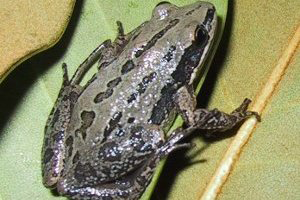
What does the species look like? The color and pattern are variable. The upper side may be light gray to tan, dark brown, or black, with blackish stripes or spots in three rows. Most individuals have a pattern that starts out as stripes or dashes anteriorly, with those markings becoming more broken and spotlike posteriorly, typically becoming more diffuse toward the posterior of the animal. The skin is punctuated with many small warts. The upper lip has a white line or series of black spots. The snout is relatively pointed. In contrast to some other chorus frogs, there is no stripe on the rear of the thighs. The rear toes are weakly webbed. Maximum size is about 1.3 inches (3.2 cm) snout-vent length. Breeding males have a dark throat. The breeding call consists of a series of several slow ratchetlike notes; basically an ascending trill, similar to the sound produced by scraping the teeth of a comb (very similar to the call of P. ferriarum, however, typically containing fewer audible pulses than that of ferriarum). Larvae are small, slender, and brown, with a gold or brassy belly; the tail fins begin at or behind the spiracle and are clear with numerous small dark marks. The tail musculature is dark. Larvae grow up to around 1.4 inches (3.5 cm) long.
Where is the species found?
States & Provinces
AL, FL, GA, LA, MS, NC, SC, VA
Distribution

Range encompasses the southeastern United States from southeastern Virginia and eastern North Carolina south to southern Florida, and west to southern Mississippi.

Southern chorus frogs inhabit pine flatwoods, pine-oak forests, sandhills, and cleared and otherwise disturbed habitats. Most of the year these frogs are primarily terrestrial, and they may burrow among plant material or into the ground when conditions are unsuitable for surface activity. Breeding sites include flooded grassy depressions, roadside ditches, margins of shallow ponds, sinkhole ponds, and other temporary pools, often including those in disturbed areas. Females attach eggs to submerged vegetation.

General Phenology and Life History Most activity occurs at night but also in daytime, especially during the breeding season. Southern chorus frogs migrate seasonally between nonbreeding terrestrial habitats and breeding sites. Breeding occurs from fall to early spring (usually with a winter peak) in the northern part of the range. For example, this species can be found active from November-May in Virginia, although most breeding and calling occur from February to early May. Breeding may occur in any month in the far south (Florida). Calling may occur day or night. Egg-laying usually is associated with heavy rains. Eggs hatch in several days. Aquatic larvae metamorphose into the terrestrial form in about 50 days (6-8 weeks). Individuals are sexually mature in one year, and few live longer than that. These frogs are seldom found outside the breeding season.
Which phenophases should I observe?
Do you see/hear...?
Activity Adults
One or more adults are seen or heard moving about or at rest.
More...

For abundance, enter the number of individual animals observed in this phenophase.
Adults on land
One or more adults are seen on land.
More...

For abundance, enter the number of individual animals observed in this phenophase.
Adults in water
One or more adults are seen in water.
More...

For abundance, enter the number of individual animals observed in this phenophase.
Adults feeding
One or more adults are seen feeding. If possible, record the name of the species or substance being eaten or describe it in the comments field.

For abundance, enter the number of individual animals observed in this phenophase.
Reproduction Vocalizing
One or more individuals are heard vocalizing.

What is the intensity of vocalizing?

  • Single calls: There is space between calls and individuals can be counted.
  • Overlapping calls: Calls of individuals can be distinguished but there is some overlapping of calls.
  • Full chorus: Calls are constant and overlapping.

Mating
A female is seen grasped and held by a male.

For abundance, enter the number of individual animals observed in this phenophase.
Fresh eggs
Eggs are seen being extruded, an egg mass is seen with jelly not expanded to full size, or embryos that are more or less spherical are seen.

For abundance, enter the number of individual animals observed in this phenophase.
Development Dead adults
One or more dead adults are seen.

For abundance, enter the number of individual animals observed in this phenophase.
What do these phenophases look like?

There is currently no photoguide available for this species. If you'd like help us create one, use the guidance document and species template provided here. Then send it via email to education@usanpn.org when it is complete.