Pueraria montana can grow up to 1 foot (30 cm) per day and up to 99 feet (30 m) in a growing season.

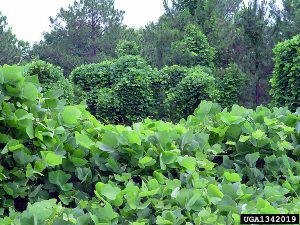
Photo Credit: © Chris Evans, River to River CWMA, Bugwood.org.
Pueraria montana
Common Name: kudzu
Plant Functional Group: Deciduous broadleaf
Class > Order > Family: Magnoliopsida > Fabales > Fabaceae
What does the species look like?

Kudzu is a prostrate and high-climbing, deciduous, herbaceous to semi-woody vine with stems growing 35 to 100 feet long, with infrequent branching. A single root crown can produce as many as 30 stems, spreading in all directions. Its lavender to reddish-purple, rarely white, flowers have both male and female parts, and are grouped on erect, spike-like, showy clusters along the stems. Flowering begins when plants become mature at about 3 years of age.

Kudzu inhabits temperate zones or higher altitudes in the tropics and can be found growing in almost all habitats from the driest flatwoods to the margins of permanent bodies of water, but not in periodically flooded soils. Typical habitats are open, disturbed sites in agricultural areas, natural forests, planted forests, range/grasslands, riparian zones, shrublands, and urban areas. It favors deep, well-drained, loamy soils and grows on a wide range of soil types, yet is limited by very light sand or poorly drained, heavy clay soils. It is drought tolerant and frost sensitive.

Where is the species found?
States & Provinces
AL, AR, CT, DC, DE, FL, GA, HI, IL, IN, KS, KY, LA, MA, MD, ME, MO, MS, NC, NE, NJ, NY, OH, OK, OR, PA, SC, TN, TX, VA, WA, WV
Special Considerations for Observing

If drought seems to be the cause of leaf color or fall for a plant, please make a comment about it for that observation.

Which phenophases should I observe?
Do you see...?
Leaves Breaking leaf buds
One or more breaking leaf buds are visible on the plant. A leaf bud is considered "breaking" once a green leaf tip is visible at the end of the bud, but before the first leaf from the bud has unfolded to expose the leaf base at its point of attachment to the leaf stalk (petiole) or stem.
More...

How many buds are breaking?

  • Less than 3
  • 3 to 10
  • 11 to 100
  • 101 to 1,000
  • 1,001 to 10,000
  • More than 10,000

Leaves
One or more live, unfolded leaves are visible on the plant. A leaf is considered "unfolded" once its entire length has emerged from a breaking bud, stem node or growing stem tip, so that the leaf base is visible at its point of attachment to the leaf stalk (petiole) or stem. Do not include fully dried or dead leaves.
More...

What percentage of the potential canopy space is full with leaves? Ignore dead branches in your estimate of potential canopy space.

  • Less than 5%
  • 5-24%
  • 25-49%
  • 50-74%
  • 75-94%
  • 95% or more

Early season leaf expansion
A majority of leaves on the plant have not yet reached their full size and are still growing larger. Do not include new leaves that continue to emerge at the ends of elongating stems throughout the growing season. (This phenophase was previously called "Increasing leaf size".)


Colored leaves
One or more leaves show some of their typical late-season color, or yellow or brown due to drought or other stresses. Do not include small spots of color due to minor leaf damage, or dieback on branches that have broken. Do not include fully dried or dead leaves that remain on the plant.
More...

What percentage of the potential canopy space is full with non-green leaf color? Ignore dead branches in your estimate of potential canopy space.

  • Less than 5%
  • 5-24%
  • 25-49%
  • 50-74%
  • 75-94%
  • 95% or more

Falling leaves
One or more leaves with typical late-season color, or yellow or brown due to other stresses, are falling or have recently fallen from the plant. Do not include fully dried or dead leaves that remain on the plant for many days before falling.
More...


Flowers Flowers or flower buds
One or more fresh open or unopened flowers or flower buds are visible on the plant. Include flower buds or inflorescences that are swelling or expanding, but do not include those that are tightly closed and not actively growing (dormant). Also do not include wilted or dried flowers.
More...

How many flowers and flower buds are present? For species in which individual flowers are clustered in flower heads, spikes or catkins (inflorescences), simply estimate the number of flower heads, spikes or catkins and not the number of individual flowers.

  • Less than 3
  • 3 to 10
  • 11 to 100
  • 101 to 1,000
  • 1,001 to 10,000
  • More than 10,000

Open flowers
One or more open, fresh flowers are visible on the plant. Flowers are considered "open" when the reproductive parts (male stamens or female pistils) are visible between or within unfolded or open flower parts (petals, floral tubes or sepals). Do not include wilted or dried flowers.
More...

What percentage of all fresh flowers (buds plus unopened plus open) on the plant are open? For species in which individual flowers are clustered in flower heads, spikes or catkins (inflorescences), estimate the percentage of all individual flowers that are open.

  • Less than 5%
  • 5-24%
  • 25-49%
  • 50-74%
  • 75-94%
  • 95% or more

Fruits Fruits
One or more fruits are visible on the plant. For Pueraria montana, the fruit is a pod that changes from green to dark brown and splits open to expose the seeds. Do not include empty pods that have already dropped all of their seeds.
More...

How many fruits are present?

  • Less than 3
  • 3 to 10
  • 11 to 100
  • 101 to 1,000
  • 1,001 to 10,000
  • More than 10,000

Ripe fruits
One or more ripe fruits are visible on the plant. For Pueraria montana, a fruit is considered ripe when it has turned dark brown. Do not include empty pods that have already dropped all of their seeds.
More...

What percentage of all fruits (unripe plus ripe) on the plant are ripe?

  • Less than 5%
  • 5-24%
  • 25-49%
  • 50-74%
  • 75-94%
  • 95% or more

Recent fruit or seed drop
One or more mature fruits or seeds have dropped or been removed from the plant since your last visit. Do not include obviously immature fruits that have dropped before ripening, such as in a heavy rain or wind, or empty fruits that had long ago dropped all of their seeds but remained on the plant.
More...

How many mature fruits have dropped seeds or have completely dropped or been removed from the plant since your last visit?

  • Less than 3
  • 3 to 10
  • 11 to 100
  • 101 to 1,000
  • 1,001 to 10,000
  • More than 10,000

What do these phenophases look like?

There is currently no photoguide available for this species. If you'd like help us create one, use the guidance document and species template provided here. Then send it via email to education@usanpn.org when it is complete.