|
Do you see/hear...?
|
| Activity
|
Live individuals
One or more individuals are seen or heard moving about or at rest.
More...
For abundance, enter the number of individual animals observed in this phenophase.
|
|
|
Feeding or foraging
One or more individuals are seen feeding or foraging. If possible, record the name of the species or substance being eaten or gathered, or describe it in the comments field.
For abundance, enter the number of individual animals observed in this phenophase.
|
|
|
Fruit/seed consumption
One or more individuals are seen eating the fleshy fruits, seeds, or cones of a plant. If possible, record the name of the plant or describe it in the comments field.
For abundance, enter the number of individual animals observed in this phenophase.
|
|
|
Insect consumption
One or more individuals are seen eating insects. If possible, record the name of the insect or describe it in the comments field.
For abundance, enter the number of individual animals observed in this phenophase.
|
|
|
Calls or song
One or more individuals are heard calling or singing.
For abundance, enter the number of individual animals observed in this phenophase.
|
|
|
Singing individuals
One or more individuals are heard singing. Singing refers to stereotypical, simple or elaborate vocalizations (most commonly by males) used as part of territorial proclamation or defense, or mate attraction. It does not include relatively simple calls used for other forms of communication.
For abundance, enter the number of individual animals observed in this phenophase.
|
|
|
Territorial individuals
One or more individuals are seen or heard defending a territory. This may be indicated by calls or song used as part of a territorial proclamation, chasing of an individual of the same species from a breeding area (but do not confuse this with courtship behavior, which in some species may involve chasing), or calls or displays directed at individuals of the same or a different species to defend a feeding area.
For abundance, enter the number of individual animals observed in this phenophase.
|
| Reproduction
|
Courtship
A male and female are seen near one another and are engaged in courtship behavior. Do not include male displays in the absence of a female.
For abundance, enter the number of individual animals observed in this phenophase.
|
|
|
Mating
A male and female are seen coupled in a mating position, usually with the male on top of the female.
For abundance, enter the number of individual animals observed in this phenophase.
|
|
|
Nest building
One or more adults are seen constructing a nest or carrying nesting material.
For abundance, enter the number of individual animals observed in this phenophase.
|
|
|
Occupied nest
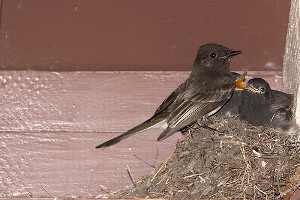
One or more adults are seen sitting on a nest, entering or leaving a nest site under circumstances indicating its use for nesting (including nest defense behavior), or live eggs or nestlings are seen in a nest.
For abundance, enter the number of individual animals observed in this phenophase.
|
| Development
|
Nestlings
One or more young are seen or heard in a nest.
For abundance, enter the number of individual animals observed in this phenophase.
|
|
|
Fledged young
One or more young are seen recently departed from the nest. This includes young incapable of sustained flight and young which are still dependent on adults.
For abundance, enter the number of individual animals observed in this phenophase.
|
|
|
Dead individuals
One or more dead individuals are seen.
For abundance, enter the number of individual animals observed in this phenophase.
|
|
|
Dead nestlings or fledglings
One ore more dead nestlings or young are seen.
For abundance, enter the number of individual animals observed in this phenophase.
|
| Method
|
Individuals at a feeding station
One or more individuals are seen visiting a feeder, feeding station, or food placed by a person.
For abundance, enter the number of individual animals observed in this phenophase.
|