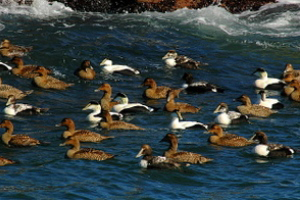
Female common eiders lead their young to water and may be accompanied by nonbreeding females that help protect the chicks. Broods often join to form "creches" of up to many dozens of young. Once formed, a creche tends to stay together throughout the brood rearing period, although some of the adult females attending it may depart.
Photo Credit: Geoffrey A. Hammerson
Somateria mollissima
Common Name: common eider
Animal Guild: Bird
Class > Order > Family: Aves > Anseriformes > Anatidae
What does the species look like?
This is a heavy-bodied duck with a relatively short, stout neck and distinctive long triangular (wedge-shaped) bill and head profile. From fall through early summer, adult males have a black crown, greenish rear of head, dark or yellow bill, black underparts, white upperparts and chest, and black tail and area around the tail. From summer to fall, adult males are dark brown to blackish overall, with a pale brown stripe through the eye, brown breast with white flecking, and back feathers white with black edges. Immature males are similar to females but have a white chest. Adult females are dark gray to rusty-brown, with fine black barring that forms lines on the flanks.
Where is the species found?
States & Provinces
AK, MA, MB, MD, ME, MI, NB, NC, NH, NJ, NL, NS, NT, NU, NY, ON, PE, QC, RI, SC, SD, VA, YT
Distribution
Breeding range extends from Alaska across the Arctic to Labrador and Greenland and south to Maine and New Hampshire; from Iceland, the Faroe Islands, Spitsbergen, and Franz Josef Land south to northern British Isles, northern Europe, and southern Scandinavia; and from Wrangel Island and northeastern Siberia south to Kamchatka and the Commander Islands. Winter range in western North America extends from the ice pack south to the Aleutian Islands, Washington, and Oregon. Winter range in in eastern North America is in Hudson and James bays and from Labrador south to Long Island (New York). Winter range in Eurasia extends from the breeding range south to central Europe in the west and Kamchatka in the east.
Nonbreeding habitat includes rocky seacoasts, bays, and estuaries. Rocks, sandbars, and ice are used as resting sites. Most migration is coastal. Nests are on the ground in grass or brush, usually close to salt water, often on an island or rocky headland or along the shore of a pond or lagoon. Nests often but not always are concealed by plants (forest, shrub, or herbaceous), rocks, logs, or driftwood.
General Phenology and Life History
Some populations do not migrate, and in other populations migration may be partially facultative, depending on conditions. Spring migration generally begins in March and extends into April for early nesters and to mid-June for arctic nesters. Common eiders commonly nest in loose aggregations or colonies (usually a few dozen pairs, but up to several thousand pairs in some areas). Females commonly deposit eggs in the nests of other females. Nesting in Maine occurs from late April to early July. Nesting in the Beaufort Sea region begins in mid- to late June. Clutch size averages 3-5. Incubation, by the female, lasts 24-30 days. The female does not feed during incubation but relies on endogenous energy reserves. Eggs hatch mainly mid- to late July (sometimes into August) in the region arctic of Alaska and Canada. Young are tended by the female and led to water soon after hatching. Soon they join young of other broods, Young are independent at around 60-75 days. Females rarely renest if the clutch is lost, unless loss occurs during laying or early incubation. During June and July, males depart from breeding areas to molt (immatures and nonbreeding females may also undertake such migrations). Fall migration varies regionally but occurs mainly in October and November, though females and young may begin moving toward wintering areas in late August-early September. By mid-December most wintering populations have peaked in numbers.
Which phenophases should I observe?
Do you see/hear...?
Activity
Live individuals More...
For abundance, enter the number of individual animals observed in this phenophase.
Feeding or foraging For abundance, enter the number of individual animals observed in this phenophase.
Calls or song For abundance, enter the number of individual animals observed in this phenophase.
Territorial individuals For abundance, enter the number of individual animals observed in this phenophase.
Reproduction
Courtship For abundance, enter the number of individual animals observed in this phenophase.
Mating For abundance, enter the number of individual animals observed in this phenophase.
Nest building For abundance, enter the number of individual animals observed in this phenophase.
Occupied nest For abundance, enter the number of individual animals observed in this phenophase.
Development
Downy young For abundance, enter the number of individual animals observed in this phenophase.
Partially-fledged young For abundance, enter the number of individual animals observed in this phenophase.
Fledged young For abundance, enter the number of individual animals observed in this phenophase.
Dead individuals For abundance, enter the number of individual animals observed in this phenophase.
Dead nestlings or fledglings For abundance, enter the number of individual animals observed in this phenophase.
Method
Individuals at a feeding station For abundance, enter the number of individual animals observed in this phenophase.
What do these phenophases look like?
There is currently no photoguide available for this species. If you'd like help us create one, use the guidance document and species template provided here . Then send it via email to education@usanpn.org when it is complete.