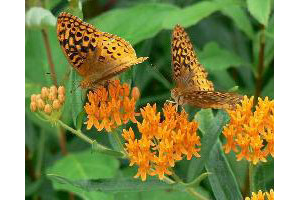
Adult greater fritillaries are among the longest lived non-hibernating butterflies in the United States. Southern females that emerge in June can live well into October.
Photo Credit: Benny Mazur
Speyeria cybele
Common Name: great spangled fritillary
Animal Guild: Insect
Class > Order > Family: Insecta > Lepidoptera > Nymphalidae
What does the species look like?
Like most greater fritillaries, great spangled fritillaries are recognized by their large size, silvery spots beneath, and orange and brown spotted uppersides, with the coloration becoming noticeably darker toward the body. Great spangled fritillaries are usually larger (wingspread about 2.2 to over 3 inches) than any co-occurring fritillaries except for the very different Diana. East of the Great Plains the wide pale marginal band on the hindwing beneath is diagnostic. In some northern regions and west of the Great Plains females are pale above, while southeastern females are nearly as orange as the smaller males. Although three other silver-spotted greater fritillaries occur in the eastern U.S., by far the most common is the great spangled. West of the Great Plains, identification of greater fritillaries can be difficult. Generally the other western species are smaller, with proportionately larger silver spots, or none at all, and with the pale hindwing band beneath narrower or absent. A regional butterfly guide should be carefully consulted to confirm identification.
Where is the species found?
States & Provinces
AB, AL, AR, BC, CA, CO, CT, DC, DE, GA, IA, ID, IL, IN, KS, KY, MA, MB, MD, ME, MI, MN, MO, MS, NB, NC, ND, NE, NH, NJ, NM, NS, NV, NY, OH, OK, ON, OR, PA, PE, QC, RI, SC, SD, SK, TN, UT, VA, VT, WA, WI, WV
Distribution
This species ranges across southern Canada and approximately the northern two thirds of the United States from coast to coast, southward to northern halves of Georgia, Alabama, and Mississippi, northern New Mexico, and eastern California. Great spangled fritillaries are absent from most of the Atlantic Coastal Plain and Nevada. Records shown on the map from places like Texas, Louisiana, and Florida probably represent strays.
The great spangled fritillary occurs in a variety of open to shrubby, usually moist to wet, habitats such as meadows, streamsides, roadsides, power line cuts, fields, pastures, prairies, and marshes, usually near forest which the adults occasionally enter. Adults wander into many habitats, including gardens, to feed at flowers. As with all greater fritillaries, an abundance of violets and reliable summer nectar sources are essential habitat features.
General Phenology and Life History
All greater fritillaries have one annual generation range wide. In warmer parts of the east, males begin to appear in May but to the north and west they start from mid June to early July. Females begin to emerge about two or three weeks later. In the East, adults usually become numerous when common milkweeds are in flower. Although they mate soon after emergence, southern females persist into September or later, and they usually lay most or all of their eggs after the hottest part of the summer. Females are less active during hot periods when they are not laying eggs. Eggs are laid near violets. The tiny caterpillars hatch in the fall and overwinter. Caterpillars commence feeding on violet leaves in the spring and do so for more than a month. The pupal stage probably lasts about two weeks in most places, but pupae are almost never found. Adults visit many kinds of flowers, especially milkweeds and thistles eastward, and require access to nectar throughout their long life.
Which phenophases should I observe?
Do you see/hear...?
Activity
Adults More...
For abundance, enter the number of individual animals observed in this phenophase.
Adults feeding Speyeria cybele , adults feed on the flower nectar of many different plant species.
For abundance, enter the number of individual animals observed in this phenophase.
Flower visitation For abundance, enter the number of individual animals observed in this phenophase.
Reproduction
Mating For abundance, enter the number of individual animals observed in this phenophase.
Egg laying Speyeria cybele , eggs are typically deposited on or near violet plants.
For abundance, enter the number of individual animals observed in this phenophase.
Eggs Speyeria cybele , the tiny, ribbed, dome-shaped eggs are initially yellow, turning brown as they develop, and are typically found on or near violet plants.
For abundance, enter the number of individual animals observed in this phenophase.
Development
Caterpillars Speyeria cybele , caterpillars are black and covered with black, branched spines. In older caterpillars, the base of each spine becomes bright orange in color.
For abundance, enter the number of individual animals observed in this phenophase.
Caterpillars feeding Speyeria cybele , caterpillars typically feed on the leaves and flowers of violet plants.
For abundance, enter the number of individual animals observed in this phenophase.
Pupae Speyeria cybele , pupae are glossy brown or black with short spines on one side, and hang from plants or other outdoor surfaces. Do not include empty pupal shells after the adult has emerged from them.
For abundance, enter the number of individual animals observed in this phenophase.
Dead adults For abundance, enter the number of individual animals observed in this phenophase.
Dead caterpillars For abundance, enter the number of individual animals observed in this phenophase.
Method
Individuals at a feeding station For abundance, enter the number of individual animals observed in this phenophase.
Individuals in a net For abundance, enter the number of individual animals observed in this phenophase.
Individuals in a trap For abundance, enter the number of individual animals observed in this phenophase.
What do these phenophases look like?
There is currently no photoguide available for this species. If you'd like help us create one, use the guidance document and species template provided here . Then send it via email to education@usanpn.org when it is complete.