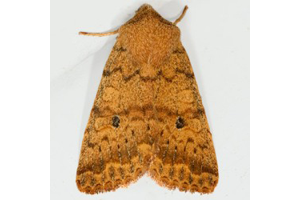
Although the caterpillar form of this moth is one of the most common forest caterpillars in eastern North America, much of the bicolored sallow's biology is poorly understood. The name "sallow" probably comes from a British term for certain broad-leafed willows. Although bicolored sallows do not occur when willows bloom, many related moths visit willows for nectar in early spring.
Photo Credit: Nolie Schneider
Sunira bicolorago
Common Name: bicolored sallow moth
Other Scientific Names: Agrochola bicolorago
Animal Guild: Insect
Class > Order > Family: Insecta > Lepidoptera > Noctuidae
What does the species look like?
The bicolored sallow is a medium-sized moth (its wingspread is 2.8-3.8 cm; 1.1-1.6 inches) commonly seen darting among trees and shrubs 5-15 feet above the ground on autumn evenings, before it is too dark for people to see clearly. Sallows are nearly always the most common moth on overipe fruits or at sugar baits in autumn in wooded parts of eastern North America. In flight they look straw-colored or more yellow, depending on the light, and can be recognized by their size, behavior, color, and often just by their abundance.
When seen up close, these moths can vary tremendously in their appearance, but not enough to hamper identification. The forewing is pale yellow to deep orange-yellow with light brown or gray shades. There are obscure gray lines running down each wing, although these lines are often reduced to a series of black dots. Bicolored sallows have a kidney-shaped spot (reniform spot) in the outer part of the forewing, and the lower half of the spot is filled with gray. The hindwing is paler than the forewing, and is shaded grayish brown. In some specimens, the outer half of the forewing is completely purplish gray. On around 1% of adults, the outer half of the forewing is dark brown. The species was first described based on one such specimen, leading to the species' name. Larvae are rarely found, even by experts.
Similar species: In the eastern United States, the only other similar species is Anathix ralla , which is brighter and has less dark shading on all wings and a conspicuous dark line beyond the forewing spots. Anathix ralla also has a series of dark dots near the edge of the forewing and has no dark shading on the hindwing. Anathix ralla adults generally appear before Sunira bicolorago adults in autumn.
Where is the species found?
States & Provinces
AB, AL, AR, CT, DC, DE, FL, GA, IA, IL, IN, KS, KY, LA, MA, MD, ME, MO, MS, NC, ND, NE, NH, NJ, NY, OH, ON, PA, RI, SC, SD, TN, TX, VA, VT, WV
Distribution
This species ranges from at least northern New Brunswick, Canada west to Manitoba, and south to eastern Texas and most of Florida. This moth is common to abundant in nearly its entire range.
This species will live virtually any place with unsprayed hardwood trees, especially maples, elms, and other trees that flower in late winter or very early spring. City parks and suburban yards are good habitats, as are forests and floodplains. Bicolored sallow moths are most common in southern swamps and northern forests with abundant red maples, but adults and larvae also occur in barrens, coastal pinelands, and oak forests. In western parts of the range, populations are typically found in stream or riverside habitats.
General Phenology and Life History
Adults fly in the fall, starting by late August in the far north, late September or early October in the mid latitudes of the United States, and normally in November in Florida and Texas. They begin mating a few weeks later; the mating season peaks for perhaps two weeks around the time of peak fall color in October or early November in most places. This is the time when adults can be seen flying among branches and thickets around sunset. As the fall progresses, fewer moths will be seen flying about in the evening, but adults can still be attracted to bait for a month or two past leaf-fall. Eggs have rarely been found in the wild. These moths apparently lay eggs in masses among flower buds of trees and shrubs such as maples, elms, and at least occasionally, highbush blueberry. Eggs overwinter and hatch in late winter or very early spring, mostly when the first red maples flower, but some egg masses hatch a few weeks later. Larvae mature around May in the mid latitudes, probably in late March and April in the south and in June in the north. Mature larvae enter the soil, spin a cocoon, and remain dormant until late summer or fall when they pupate. It is not really certain where, or on what, older larvae normally feed.
Which phenophases should I observe?
Do you see/hear...?
Activity
Adults More...
For abundance, enter the number of individual animals observed in this phenophase.
Adults feeding Sunira bicolorago , adults feed on rotting fruit.
For abundance, enter the number of individual animals observed in this phenophase.
Reproduction
Mating For abundance, enter the number of individual animals observed in this phenophase.
Egg laying Sunira bicolorago , eggs are deposited near the buds of deciduous trees or shrubs.
For abundance, enter the number of individual animals observed in this phenophase.
Development
Caterpillars Sunira bicolorago , caterpillars are light brown to orange-brown and have a band of dark brown triangles down their back.
For abundance, enter the number of individual animals observed in this phenophase.
Caterpillars feeding Sunira bicolorago , caterpillars feed on the leaves of many different plant species.
For abundance, enter the number of individual animals observed in this phenophase.
Dead adults For abundance, enter the number of individual animals observed in this phenophase.
Dead caterpillars For abundance, enter the number of individual animals observed in this phenophase.
Method
Individuals at a feeding station For abundance, enter the number of individual animals observed in this phenophase.
Individuals at a light For abundance, enter the number of individual animals observed in this phenophase.
Individuals in a net For abundance, enter the number of individual animals observed in this phenophase.
Individuals in a trap For abundance, enter the number of individual animals observed in this phenophase.
What do these phenophases look like?
There is currently no photoguide available for this species. If you'd like help us create one, use the guidance document and species template provided here . Then send it via email to education@usanpn.org when it is complete.