Mourning dove parents produce "crop milk," a liquid high in protein and fat used to feed chicks for the first few days after hatching. When the chicks are a little older, the parents add an increasing volume of regurgitated seeds to the diet. The male often cares for the fledglings while the female begins laying her next set of eggs.
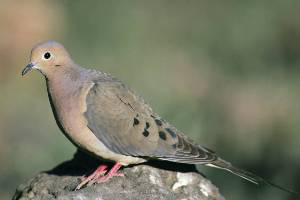
Photo Credit: Dave Manke
Zenaida macroura
Common Name: mourning dove
Animal Guild: Bird
Class > Order > Family: Aves > Columbiformes > Columbidae
What does the species look like?
Size and color vary somewhat across the range, but mourning doves are usually gray to brown above and a little lighter below, with darker wings and tail. The wings have conspicuous black spots, and the tail feathers have black-bordered white tips. Juveniles have a patterned face and faintly spotted breast; pale edges are evident on the feathers (upper coverts) of the folded wings. Like other doves, mourning doves are fast, direct fliers.
Where is the species found?
States & Provinces
AB, AL, AR, AZ, BC, CA, CO, CT, DC, DE, FL, GA, IA, ID, IL, IN, KS, KY, LA, MA, MB, MD, ME, MI, MN, MO, MS, MT, NB, NC, ND, NE, NH, NJ, NL, NM, NS, NV, NY, OH, OK, ON, OR, PA, PE, QC, RI, SC, SD, SK, TN, TX, UT, VA, VT, WA, WI, WV, WY
Distribution
The mourning dove breeds from southern Canada southward through the United States, Cuba, and much of Mexico. It winters within this area south of Canada and south into Panama.
The mourning dove is very versatile, breeding almost anywhere except in deep forest, including woodlands, grasslands, agricultural lands, suburbs, and urban parks. Nests are located on the ground, on ledges, or in vegetation. Habitats used during migration are similar to breeding habitat. Detailed accounts of winter habitat use are lacking, but winter roost sites appear to consist of small- to medium-sized woodlots with suitable protection from the elements.
General Phenology and Life History
Although some birds may move locally south in the fall, mourning doves overwinter throughout much of their breeding range, making it difficult to describe the timing of migration. Populations at the northern fringe of the range are completely migratory. In general, birds that do migrate head south between September and November and northward migrations in the spring occur in April and May. The nesting season is very long. Egg-laying may begin as early as February in some areas, and the last young may be fledged in October. Clutch size is usually 2. Incubation lasts about 14 days, and the young leave the nest 12-15 days after hatching. Mourning doves have multiple broods and in some areas may attempt up to 6 nestings in a single breeding season.
Which phenophases should I observe?
Do you see/hear...?
Activity
Live individuals More...
For abundance, enter the number of individual animals observed in this phenophase.
Feeding or foraging For abundance, enter the number of individual animals observed in this phenophase.
Calls or song For abundance, enter the number of individual animals observed in this phenophase.
Singing individuals For abundance, enter the number of individual animals observed in this phenophase.
Territorial individuals For abundance, enter the number of individual animals observed in this phenophase.
Reproduction
Courtship For abundance, enter the number of individual animals observed in this phenophase.
Mating For abundance, enter the number of individual animals observed in this phenophase.
Nest building For abundance, enter the number of individual animals observed in this phenophase.
Occupied nest For abundance, enter the number of individual animals observed in this phenophase.
Development
Nestlings For abundance, enter the number of individual animals observed in this phenophase.
Fledged young For abundance, enter the number of individual animals observed in this phenophase.
Dead individuals For abundance, enter the number of individual animals observed in this phenophase.
Dead nestlings or fledglings For abundance, enter the number of individual animals observed in this phenophase.
Method
Individuals at a feeding station For abundance, enter the number of individual animals observed in this phenophase.
What do these phenophases look like?
There is currently no photoguide available for this species. If you'd like help us create one, use the guidance document and species template provided here . Then send it via email to education@usanpn.org when it is complete.